
What is Cryptocurrency - is it halal?

Introduction
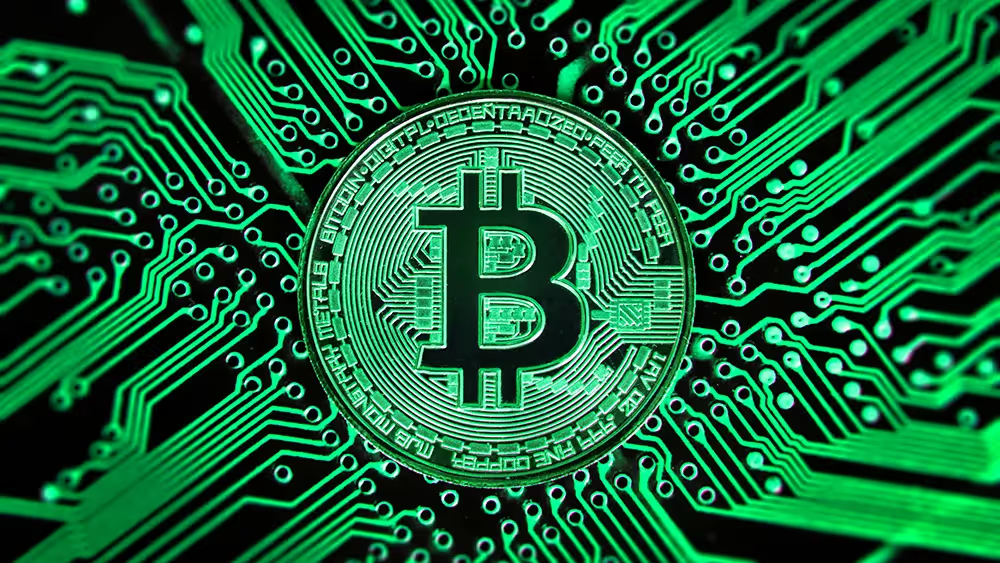
Cryptocurrency is essentially a digital currency exchange and digital payments platform that uses blockchain technology. The technological and digital revolution over the last few decades has meant that innovative payment systems have been created and utilised, and cryptocurrency is one of the major breakthrough payment systems for business and personal finance use. Whether or not cryptocurrency is halal or haram is a debate that is ongoing between Islamic scholars.
This article will examine cryptocurrency, Islamic interpretations, and the types of cryptocurrencies available.
Cryptocurrency
Although there are over 2,000 cryptocurrencies on the market now, Bitcoin is probably still the most known form of cryptocurrency in the blockchain market, and was the first cryptocurrency coin to go mainstream but there are other cryptocurrencies entering the market.
For Muslims across the Islamic world, the question arises as to whether crypto payment platforms are deemed to be halal or haram in the eyes of Allah and in accordance with Shariah principles, and whether as a currency it prevents money laundering. Whether or not cryptocurrency is halal or haram depends on the how a specific cryptocurrency aligns with the principles of Islam.
Cryptocurrency - Characteristics
One of the defining aspects of cryptocurrency is that there is no central authority such as a Government that authorises it or records it. Cryptocurrencies operate on decentralised networks using blockchain technology.
Most cryptocurrencies have a limited supply, or at least a capped supply. Transactions are transparent and traceable, but there is also a degree of anonymity of parties. One the main advantages of cryptocurrency is that it offers global accessibility. It can be received anywhere in the world - all you need is an internet connection.
For Muslims, cryptocurrency does tick a lot of the Islamic finances boxes when it comes to transparency and traceability. However, ultimately it is the duty of every Muslim to be seeking knowledge, and this guide will address the use of the cryptocurrency market and its intrinsic value.
This article will consider whether crypto currency is permissible as a form of actual money under Islamic laws and in the Islamic world. We will consider the views of Islamic jurists and scholars on this emergence of what is considered to be new money addressing the question of is cryptocurrency halal.ISLAMIC SCHOLARS INTERPRETATION - IS CRYPTOCURRENCY HALAL?
A comprehensive Islamic law interpretation, one that sparked a massive rise in Muslim investment in Bitcoin and Ethereum in 2018, was provided by Sharia advisor Mufti Muhammad Abu-Bakar (former advisor to Blossom Finance) who looked at the question of is cryptocurrency halal as a money supply. He argued that Bitcoin is permissible under Islamic principles.
Mufti Abu-Bakar considered arguments that crypto itself was speculative when it comes to personal finance, but his view was that all currencies have a speculative element and this did not automatically deem cryptocurrency as haram.
Crypto Currencies
Islamically, if a business does not have an element of appropriate loss probability within its assets is not strictly trading in a Sharia compliant manner. The Grand Mufti of Egypt, Shaykh Shawki Allam believes that cryptocurrency is haram and he is joined by other Shariah scholars from the Middle East and beyond including Shaykh Haitham Al Haddad who see crypto as high risk. Their argument is based on the notion that crypto itself does not hold enough credibility as a currency to be deemed to be halal.
However, many other Sharia scholars believe that crypto itself does confirm to Sharia money rules and Muslims are permitted to invest in crypto.
Islamic scholars who believe that cryptocurrency money and digital assets are halal include Ziyaad Mahomed, Shariah Committee Chairman of HSBC Amanah Malaysia Bhd, and Mufti Faraz Adam. These views lend credence to the notion that Muslims can invest in crypto.
Arguments in favour of crypto being deemed halal include:
- There is often a lack of riba (interest). Crypto operates on decentralised platforms without any central authority. This usually means there is no interest charged or payable.
- Crypto is used as a medium of exchange with a legitimate purpose in financial and economic transactions.
- Technologically, crypto is neutral. Scholars argue that it is the use of the crypto that determines if it is Sharia compliant or not.
- The fact that crypto is generally thought to be scarce means that it is easier to avoid speculation and uncertainty and this aligns with Islamic finance rules.
Islamic Scholars
As mentioned above, one of the main reasons Islamic jurists and scholars from Muslim countries argue that cryptocurrency is halal, is that the concept of the blockchain and other cryptocurrencies are inherently anti-interest when looked at from a money generation source or perspective. Crypto operates outside of conventional banking systems and interest-based transactions.
Islamic banking laws are also anti-interest so the technology, pricing, and buying and selling of cryptocurrency money is deemed halal by many Islamic scholars who rely on the teachings of Prophet Muhammad PBUH when seeking guidance about permissibility (ultimately, only Allah knows best).
Given that crypto has a finite supply, it is less likely to be subject to inflation. This means it can maintain a fairly stable value - again an important element of Islamic finance.
Crypto Blockchains And Islamic Finance Principles
Blockchains refer to the blocks of technology used to record digital cryptocurrency transactions. Blockchains act as a system of record and the reason this form of technology is so important is that it is virtually impossible to hack, change or cheat the blockchain platform or marketplace.
With the use of blockchain, centralized financial institutions and establishments are not needed as no central control is required. This also means that crypto trading (and the stock market) is more transparent.
According to many Islamic scholars and religious leaders, this addresses the question of is crypto halal within Islamic Finance rules and Islamic law more generally.
As cryptocurrency money is deemed permissible and halal under Islamic Sharia rules this has unlocked the crypto investment market to a global Muslim community with increasing numbers of Muslims with an interest in buying crypto and use it as a form of currency.
In terms of business practices, there are some basic principles (discussed in this article) relating to crypto and cryptocurrency trading that help many Muslims to decide if their entrepreneurial journeys and endeavours are permissible or strictly prohibited.
Consideration And Commercial Value - Is Crypto Halal Or Haram
From the perspective of Islamic contract rules, there must be an element of consideration when answering the question is crypto halal - there must be Mal. Mal refers to possession and effective storage, and cryptocurrencies meet the criteria required as they can be possessed and stored and have commercial value (Mutaqawwam).
Crypto is a real and viable digital asset, its worth and value lies in what is paid for it, and it is capable of being owned and traded commercially so the Shariah requirements are satisfied and the the question of is crypto halal can be answered.
Shacklewell Lane Mosque
The Shacklewell Lane Mosque in East London became one of the first mosques in the UK to accept cryptocurrency donations and Zakat contributions in 2018 during Ramadan. This mosque deemed cryptocurrency halal and permissible and generated a lot of interest on the topic of the permissibility of crypto more generally under Islamic law.
Digital Currencies, Money Laundering And Shariah Law
Islamic finance principles dictates that in order for income, or investing in any product or asset, to be deemed halal it has to meet certain criteria. The principles of Shariah law should be applied to the financial systems we operate in and there has been some discussion amongst Muslim scholars about whether rules devised centuries ago can still be applied to a technologically modern digital financial marketplace.
Whether cryptocurrency is halal or haram centres on the rules of Sharia law.
Is cryptocurrency halal? For many Islamic scholars, the answer quite simply is yes. Shariah principles can be applied to modern crypto analysis and digital currencies as they are based on social justice, accountability and ethics which transcend all forms of financial transactions. As long as there is no illegal activity, then trading or investing in crypto should not be deemed to be contrary to Shariah principles.
Investments, Islamic Banking Law And Illegal Activities
There has been some discussion amongst Muslim scholars around the use of cryptocurrencies for illegal activities such as gambling, drugs, and money laundering. Critics of Bitcoin also argue that it is not legal tender as it is not backed by any central government that assigns its value and maintains regulatory standards, and it is therefore deemed to be speculated trading.
However, Islamically the use of an item that is deemed halal for an unlawful purpose does not make the original item halal. Whether it is halal or haram depends on the multiple factors.
Currency Ownership
Ownership of the currency remains with the owner according to Muslim scholars, and the coins/tokens are kept in an e-wallet. This means that investors can take part in trading as and when they want, retaining control of their assets.
As mentioned above, the publication of the working paper conducted by Mufti Muhammad Abu Bakr clearly identified that cryptocurrency is permissible under Shariah rules.
For Muslims worldwide this could have huge implications for the payment of Zakat monies that are made to the poor and to charities globally. If Muslims make up 25% of the world's population and hold approximately £1.04 billion in bitcoins, this means that £26 million is due in Zakat contributions. [1]
Medium Of Exchange
Cryptocurrency operates as a medium of exchange across the globe. This means that it can operate in legally diverse and unpredictable environments, often making it more accessible than mainstream finance options. It is a valid form of currency that holds purchasing power.
Although vulnerable to market changes, crypto coins such as Bitcoin and Ethereum are deemed to be a legitimate medium of exchange, available for use in transactions and trading. Although crypto has not yet reached the status of being a globally accepted medium of exchange, it is fair to say that it is on the way to becoming so. Commentators expect crypto to appreciate over the course of time and to store value.
Cryptocurrency Guidelines
The development of Shariah compliant cryptocurrency guidelines provides Muslims with the opportunity for ethical investments. From a financial perspective, Islamic charities could benefit hugely from Zakat and other donations as a result of crypto investment.
Many banks and financial establishments globally are recognising crypto as a financially viable medium of exchange, and this makes it easier for investors to continue to trade, buy and sell cryptocurrency.
With billions of Muslims worldwide, and the growth of crypto, it seems clear that what is perhaps needed is some form of shariah compliant cryptocurrency guidelines for Muslims to follow. This would enable Muslims to assess themselves the validity of cryptocurrency when assessed against Islamic finance rules.
Contracts
In terms of whether contracts relating to crypto are Shariah compliant, given that the contractual relationships in crypto are based on smart contracts using blockchain technology, this means that the process can be made increasingly secure and automated.
This not only reduces administrative complexities, confusion and errors, but also ensures that banks are more likely to accept the contractual relationships created.
In demonstrating Shariah compliance, cryptocurrency is earning legitimacy across the Islamic finance world. Cryptocurrency agencies are springing up across the Muslim world such as One Gram in Dubai, and Hello Gold in Malaysia.
This adds further legitimacy to the rulings that cryptocurrency is halal and can be utilised by Muslims and Islamic financial institutions. Of course, there needs to be ongoing discussion to consider is crypto halal as it operated within a dynamic and changing industry.
As the crypto market continues to evolve more questions will need to be asked, and each crypto coin should be analysed against Islamic finance principles to check for permissibility. However, as things stand right now, crypto is recognised as an asset under Sharia law and this lends it legitimacy. The things to be careful of are making sure that any cryptocurrency you are involved in does not link to any haram things and industries or activities or any form of money laundering.
Whilst there is no central body who can make a final ruling on whether crypto is halal or haram, but as there is no element of interest (riba) and no exorbitant fees relating to crypto the interest from Muslims is growing. Crypto can be used within Islamic finance principles to make ethical investments and wealth management in a Shariah compliant way. This could unlock the cryptocurrency investment market to billions of Muslims worldwide who are looking to enter the crypto market as investors.
As the currency is still in its infancy it is important to keep an eye on all new developments and to assess and analyse changes in the marketSource:
[1] https://www.independent.co.uk/life-style/gadgets-and-tech/news/bitcoin-halal-london-mosque-donations...
Receive insights on ethical financing and Islamic finance directly to your inbox.
Explore more news
The United Kingdom is going through a turbulent financial and economic situation. Coming out of the pandemic, navigating the financial landscape and the economy has resulted in the highest inflation we have seen in decades, alongside stagnant wages and rises in energy bills.
The cost of everything is increasing and it is ordinary people who are struggling. From the National Health Service, to the private sector, and across every community we are all feeling the pinch.
Whilst we expect the government to ensure there is sufficient funding and investment in communities, families, and industries, what is clear is that we all need to be taking steps to minimise the risk of financial losses.
Whilst the government seems more focused on climate action, decarbonisation, and reducing emissions than effective financial planning, as individuals we need to take responsibility for our own actions.
Now is the time for us to be examining out own finances and expenditure.
As we move forward into 2024 and beyond there are some key steps you can take to make sure you are in the best financial position you can be.
Get Informed
Before we move on to the steps we can take to improve our finances, we need to consider our own financial literacy.
As individuals and communities we need to prioritise learning about and understanding finance. Prepare for the future by taking the time to learn about the key principles around money and money management. Learn how interest works, and why it is deemed to be haram in Islam.
As consumers, we need to scrutinise and assess our impact on our finances and understand how we spend and save.
The more information you have the better. The worst thing you can do is bury your head in the sand.
Start by getting details of all your bank accounts, savings, direct debits and debts. Understand your incomings and outgoings and make sure you are living within your means.
One of the key principles of Islam is to live within your means. This encourages people to be mindful of how they consume and spend, and to avoid extravagance.
There are also stringent obligations to ensure that you stay away from riba (interest) and haram spending. You cannot do this properly unless you understand your finances fully.
Knowing your finances means you can avoid haram practices. Also, in order to plan effectively for the future you need to understand how your money is saved, whether it accrues interest, and how much you can save each month.
There is ample information and advice on this website to guide you along the way. In addition, technology is so advanced that these days we can check all our accounts and finances using our mobile phones. As a result, you can keep a close eye on your finances.
Focus On Sustainable And Responsible Consumption And Investing
Focusing on sustainable and responsible consumption is key for everyone, but especially Muslims who want to live in a Sharia compliant way. Islam encourages ethical and socially responsible behaviour in every area of life.
We are required to make a commitment to being sustainable and responsible. Over-consumption goes against Islamic finance principles.
Some of the best ways of achieving a more halal and sustainable level of consumption include:
- The concept of amanah
- Islam considers money and wealth to be an amanah from Allah. What this means is that Muslims act as stewards of the wealth and will be held accountable for how they use and spend it. Sharia rules guide us to use the wealth in morally and ethically sound ways, and Islamic finance provides us with the structure in which to do this. The construction of Islamic finance principles helps us to make sure we operate within Islamic principles when it comes to our finances. In personal terms, it means that we should be more considered and careful with our finances, avoiding excessive spending, and always taking care to mind our money.
- Avoiding waste
- Any kind of waste should be avoided, and this includes wasteful purchases and spending. Responsible consumption aligns with the principle of stewardship. Keep an analysis of what you spend on and how you spend and you will be able to identify and report on poor spending and then eliminate it.
- Avoiding haram but invest wisely
- As Islam prohibits actions that cause harm to others, we need to be mindful of any spending that is deemed to be haram. This includes investing in industries that are haram such as gambling, alcohol and porn industries. Instead, we should look at halal investment options and services.
- There is a huge social impact to investing in haram industries. Be mindful of where your sums are stored and being invested. The corporate world may be focused on profits, but there are socially responsible and Sharia compliant industries you can invest in. There is also increased regulation and protective policy of most investment options across the United Kingdom which means you can be assured that your money will be safe.
Think Long Term
As mentioned above, try and think long-term. When it comes to your finances, whilst it may seem like you are living from one pay day to the next, there are some small steps you can take to plan for the future. As the old saying goes - fail to prepare, prepare to fail.Planning ahead can relieve the pressure you face tomorrow. The market is fluctuating and temperamental now but it will not always be like this.
Planning ahead builds financial stability and means you can cope with emergencies when they arise. Think of the scenario of when you are much older and unable to work as hard.
Living from one pay day to the next can result in more and more people turning to debt and credit to cover their everyday expenses. Long-term financial planning helps break the cycle of debt. The UK has an ageing population, so it is even more important that we plan ahead and make the right financial decision for our future.
Here are some steps you can take to effectively plan ahead:
- Set some financial goals: these do not have to be complicated or difficult. Instead, they should be realistic. For example, one goal could be to start saving for a home.
- Create a budget: once you have a goal, go through all your financial data including incomings and outgoings. Try and track your spending to see where you can cut back and what you can do cheaper. This will help you identify any spare funds for saving. Even £5 a month will help.
- Have an emergency fund: to stop yourself from falling into debt, try your very best to have an emergency fund.
- Save and invest regularly: consistent investing, even with the tiniest amounts, can accumulate over time. When dealing with the increasing cost of living, we need to have some money set aside for emergencies.
- Ditch the debt: overspending is one of the fastest ways to end up in debt. If you are in debt there is help and support out there, so reach out and see if you can reduce your debt and lower your spending.
For Muslims, financial literacy means they can plan and prepare responsibly. It also means they can account for their zakat payments which are obligatory.
Embrace Islamic Finance Principles
Muslims are obliged to follow the Sharia rules relating to finance. For Muslims, true success comes with pleasing Allah.
Embracing Islamic finance principles is extremely important for those wanting to be compliant with Islamic rules relating to financial dealings, but also for those wanting to live and manage their money responsibly.
Islamic finance prohibits any form of interest - that includes payment of interest or receipt of it. The whole idea behind avoiding interest is that this creates a fairer society and does not burden one group more than others. Interest is seen as being rooted in unethical and irresponsible economics.
Islamic finance is based on social justice and fairness. Islam places great emphasis on ethical behaviour, through choice. This means there is an obligation on Muslims to treat all their social and economic dealings with care.
Another key concept from Islamic finance is the idea of profit and loss sharing. Sharia rules encourage profit and loss sharing arrangements. This is to ensure that both parties are treated fairly.
For Muslims looking to save costs and stay away from debt, focusing on Islamic finance rules means they can operate Islamically but also in a way that maximises their money and makes it go further.
Establish Zakat And Sadaqa
Establishing zakat and sadaqa are critically important in Islam. Zakat is an obligation upon all Muslims, whilst sadaqa is voluntary but hugely encouraged.
In order to pay your zakat you need to understand your finances fully. Calculating and paying zakat on an annual basis is essential for Muslims.
Working out your zakat requires an important wealth assessment and analysis calculation. What it means is that through the whole year you are more conscious of your spending and you are making plans for the payment of zakat.
Zakat encourages people to be aware of their financial assets and situation. This prevents the problem of not knowing how much zakat you need to pay.
Understanding the importance of zakat and sadaqa actually encourages savings throughout the year. It also helps people to budget and plan accordingly. Also, by paying zakat people are able to understand the importance of distinguishing between needs and wants in their own lives.
Sadaqa, whilst voluntary, generates a feeling of generosity, compassion and empathy. By willingly sharing our wealth with others it means we are attuned to the needs of others and can budget accordingly.
Stay Away From Debt And Interest
Now is the time to really understand and analyse your spending habits. Make more informed choices about where to spend and save your money. This encourages a more balanced and moderate lifestyle.
Managing your debt is always a good risk management strategy. If you have a credit card then try and stop using it and clear any debt you owe. Credit card debt carries high interest rates and is deemed haram.
Staying away from debt is one of the best financial decisions you can make for yourself. Debt can lead to financial strain, and negatively impacted credit scores. It also means you have overall less disposable income from jobs, and this limits you being able to set goals, save and invest for the future. This will give you greater peace of mind when preparing for the future.
Qardus Ltd do not provide financial or investment advice. It is recommended that you seek your own independent advice from a qualified professional.
WHAT IS ISLAMIC FINANCE?
Islamic finance is a financial system based on Sharia principles - the religious law enshrined within Islam. Islamic finance offers an alternative financial system to the conventional systems, and is based on fairness, transparency, and social justice.
WHO USES ISLAMIC FINANCE?
Islamic finance is a growing industry and is used extensively by Muslims throughout the world. However, more and more non Muslims are also looking at Islamic finance services as they want to operate in a more ethical way.
DO MUSLIMS PAY INTEREST IN THE UK?
Whilst Muslims are discouraged from paying or earning interest in any form under Islamic finance rules, many Muslims in the West do pay interest. However, more and more Muslims are becoming aware of alternative financial systems and products that enable them to access loans and financial services that are compliant with Sharia law.
CAN MUSLIMS TAKE LOANS?
Yes, of course. Taking a loan is not prohibited in Islam. However, it is important to ensure that the loan terms are compliant with Sharia rules.
HOW DO ISLAMIC LOANS WORK?
Islamic loans are structured and developed to ensure they are halal - that is they do not contravene any rules in Islam relating to finances. For example, an Islamic loan will not have any element of interest attached to it.
WHY CAN'T MUSLIMS EARN INTEREST?
In Islam, interest is seen as exploitative as it leads to the lender making a profit at the expense of the borrower. Islam views interest as the unfair accumulation of the wealthy and this can lead to financial distress for those who need to borrow money. Interest is viewed as being against the promotion of social justice and economic fairness which are key concepts underpinning Islamic finance.
WHAT IS HARAM IN ISLAMIC FINANCE?
The following are deemed haram in Islam: riba/interest, gambling, excessive uncertainty, investment in haram industries or practices.
WHAT IS ETHICAL FINANCE?
While there is no universally accepted definition of ethical finance, the Ethical Finance Hub describes it as "A system of financial management or investment that seeks qualitative outcomes other than purely the management of returns. Outcomes sought may reflect ideas from faith, social, environmental and governance theories."
IS ISLAMIC OR SHARIA-COMPLIANT FINANCE ETHICAL?
The World Bank mentions that Islamic finance is ethical, sustainable, environmentally and socially responsible finance. It promotes risk sharing, connects the financial sector with the real economy, and emphasizes financial inclusion and social welfare.
While there is no universally accepted definition of ethical finance, the Ethical Finance Hub describes it as "A system of financial management or investment that seeks qualitative outcomes other than purely the management of returns. Outcomes sought may reflect ideas from faith, social, environmental and governance theories."
Introduction
Zakat is the third pillar in Islam and plays a significant role in the way Muslims live and conduct their financial affairs. The recipients of zakat are a very specific group of people as outlined in the Quran, and there is a specific calculation involved.
Our online zakat calculator assists with calculating the amount of zakat that is owing.
Understanding Zakat And Its Obligations
WHAT IS ZAKAT?
The word zakat means growth and purification in Arabic and refers to the mandatory obligation to give a portion of wealth accrued to charity. Zakat is a fundamental obligation for all Muslims who meet the criteria, and its purpose is to purify wealth and create economic equality and enhance social welfare.
According to Islamic teachings, zakat is a fundamental act of worship. The Quran (2:110) states: 'Establish prayer and give zakat'
WHO NEEDS TO PAY ZAKAT?
Muslims who are required to pay zakat must first understand if they have accrued the minimum amount of wealth required before they become eligible to pay zakat. This is known as nisab and this is worked out based on the equivalent of 85 grams of gold or 595 grams of silver.
Those eligible to pay zakat include the following:
- Adults who have reached puberty and have wealth over the nisab threshold.
- Adults who have full mental capacity.
WHAT ASSETS COUNT TOWARDS ZAKAT?
Zakat is payable on different types of wealth:
- cash
- silver
- gold
- business assets
- investment income
- agricultural produce.
When And How Much Zakat To Pay
Zakat is due on wealth that you have been in possession of for one lunar year. It's also important to note that you can deduct immediate debts from zakatable wealth (see below).
You can pay zakat at any time of the year through instalments or in one lump sum.
Calculating Zakat Step-By-Step Using A Zakat Calculator
Muslims are expected to pay 2.5% of their zakatable wealth every year. Follow these steps to work out how much zakat you need to pay:
- Determine your zakatable wealth total by adding up your assets and deducting immediate debts.
- Ensure that you meet/exceed the nisab threshold
- Apply the 2.5% rule
- Use the online zakat calculator to work out what you need to pay
Always visit a reliable zakat calculator website.
Deductions And Liabilities
There are certain debts and liabilities that be deducted when making your zakat calculation.
The following deductions are allowed:
- short term debts such as credit card balances and small loans that become due in the zakat year.
- for long term debts such as mortgages you can only deduct the payment owing in that zakat year.
- living expenses including bills, rent, good costs, transport.
- unpaid wages to employees.
- business liabilities for the zakat year.
Please note that future debts and expenses are not deductible.
Zakat Payment And Its Impact
Zakat is more than a financial payment, it goes beyond wealth distribution into the realms of spiritual growth, economic justice and fulfilling an important religious obligation.
Paying zakat on time fulfils an essential Islamic obligation and strengthens the relationship with Allah.
Timely payment of zakat leads to increase in blessings and purification of our wealth.
How To Pay Your Zakat
Zakat can be paid in different ways. You can pay zakat direct to individuals who are eligible to receive zakat. Zakat can also be paid to charities and global zakat funds.
Many Muslims choose to pay zakat online by utilising online zakat calculators.
Receiving Zakat
There are eight groups of people to whom zakat can be given:
The needy (this includes people whose earnings fail to cover basic needs such as food, home, water, clothing)
Those in poverty (who have little to no personal belongings and no means of earning a living)
Those employed to administer zakat monies
The wayfarer
People whose hearts have been reconciled to the faith In the cause of Allah (SWT)
People in debt
People in bondage
Recipients of zakat should not be members of your immediate family such as your spouse, parents or children. Other non-immediate relatives can be recipients of your zakat payments.
Many people give to charity throughout the year, for any donation to qualify as fulfilment of the zakat obligation, then there must be an intention to give the money as zakat.
Common Questions And Expert Advice
WHAT IS NISAB?
Nisab is the minimum amount of wealth you need to have before you become eligible to pay zakat. Typically nisab is the equivalent of 595 grams of solver or 85 grams of gold.
DO I PAY ZAKAT ON MY HOME?
Zakat is not payable on your primary home. If you have rental properties then zakat is payable on the income generated.
CAN I GIVE ZAKAT TO MY FAMILY?
You cannot give zakat to immediate family, ie those already dependant on you such as your partner and children. You can pay zakat to extended family members if they are eligible.
ARE ONLINE ZAKAT CALCULATORS ACCURATE?
Yes, as long as you insert the correct information based on your personal circumstances then zakat calculators are an excellent way to calculate your zakat.
IS ZAKAT PAYABLE ON MY RETIREMENT SAVINGS?
If you have full access to these savings and you meet the nisab threshold then zakat is payable.
WHAT IF I FORGET TO PAY ZAKAT?
Use an online zakat calculator to calculate what you owe and pay your zakat as soon as you can.
IS ZAKAT PAYABLE ON STOCKS AND SHARES?
Yes, if the value exceeds the nisab threshold then zakat is payable.
SHOULD NISAB BE CALCULATED ON GOLD OR SILVER VALUES?
In the United Kingdom you can use either the gold or silver value. Many scholars believe that using the value of silver is preferable as it means the amount of zakat increases. If you have assets that mainly consist of gold then it is sensible to use the gold nisab.
WHAT IS THE ZAKAT YEAR?
The zakat year begins on the date on which you first possessed the wealth that took you over the nisab threshold. This will be the start of your zakat year. The zakat payment will therefore become due when the year has elapsed.
HOW DOES ZAKAT APPLY TO YOUR INVESTMENTS ON THE WARDUS PLATFORM?
For all of you that pay zakat, it would be on the total outstanding amount payable to you from your investments via Qardus. The investment is based on a financing arrangement which involves the buying and selling of commodities, and therefore, we believe that these assets are zakatable in nature. Therefore, investors who pay zakat would use the capital plus the profit due to them to calculate the amount of Zakat payable.
Please note that Qardus does not provide tax or other financial advice and that if advice is needed, you should consult an appropriately qualified professional.
Conclusion
Calculating zakat accurately and paying it in a timely manner ensures that it reaches the most vulnerable in society. Paying zakat fulfils one of the core pillars of Islam.
Using an online zakat calculator not only ensures the payment you make is calculated accurately, it saves you time and helps you to make the sometimes complex set of calculations.
Zakat calculators also guide you to eligible recipients and make it easier for you to track your zakat payment history and accountability. The calculations eradicate errors and provide an audit trail. If you have any specific questions about your zakat payment, always remembers to consult with expert scholars.
Use the Qardus zakat calculator here.
Please note that the prices information and values mentioned above are for example purposes only. For an accurate figure of the zakat you are liable to pay then it is always best to use the zakat calculator, and also conduct your own research and obtain qualified advice where required.
Qardus do not offer financial or tax advice and if advice is needed, this should be sought from a qualified professional.

Stay informed on finance