
Fintech Startup In Ethical Finance | Sharia-Compliant

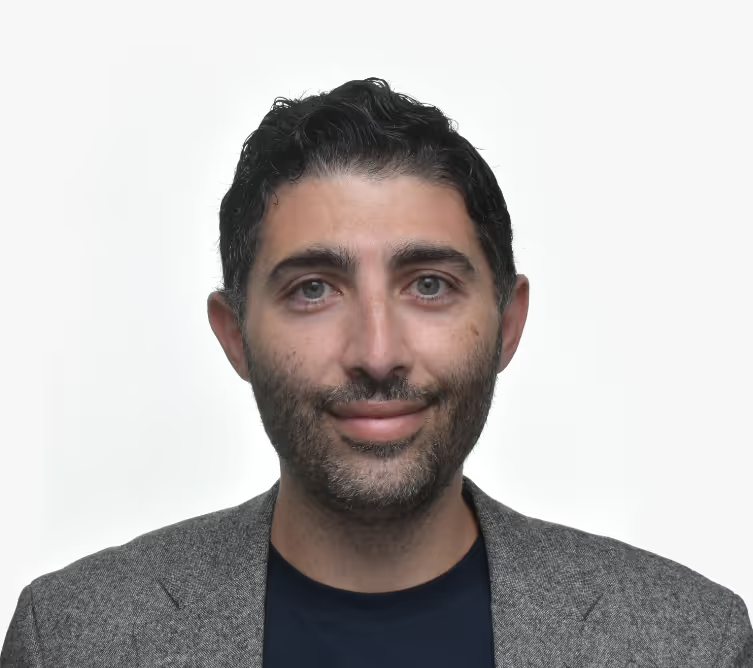
In this week’s Company Focus segment,JEVITHA MUTHUSAMY shines the spotlight on Qardus, a new Islamic fintech start-up aspiring to close the SME financing gap in the UK.
The beginning
It took the Qardus team 10 months to conceptualize, build, test and launch its Shariah compliant peer-to-peer financing platform on the 3rd July 2020. “I wanted a platform that offers fast and affordable Shariah compliant business financing to SMEs,” Hassan Daher, the founder and CEO, tells IFN. Qardus offers SMEs a chance at alternative financing as they believe many SMEs are not eligible for bank financing.
Market Insiders reported that the funding gap in the UK has grown to US$77 billion as of 2019. The largest hurdle the start-up faced was securing the right approvals. The firm is an appointed representative of Share In which is regulated by the UK’s Financial Conduct Authority while Qardus’s Shariah compliance is monitored and approved by Amanah Advisors.
“It is important for us to be Shariah compliant as there are over 950,000 SMEs in the UK that are financially excluded due to the lack of financial products that conform to their ethics and beliefs,” notes Hassan.
The presentQardus currently offers Shariah compliant working capital financing up to a maximum of GBP100,000 (US$125,640) and is targeting small businesses with GBP100,000 in revenues or assets.
“Due to the pandemic we are focusing on recession-proof industries. If you look at the small business on our site, it is essentially pharmacy and pharmaciesare doing really well right now, food manufacturing companies are also one of the sectors that are doing well,” explains Hassan.
While market opportunities are immense, Hassan acknowledges that it is a competitive segment especially with the emergence of new government initiatives in response to COVID-19 such as the Bounce Back Loan Scheme and the coronavirus business support loans.
The futureNevertheless, Qardus is working on distinguishing itself by being able to predict credit risk better than its competitors by using machine learning algorithms.
Over the next year, Qardus is looking to onboard around 150 SMEs with financing totaling an estimated GBP15 million (US$18.85 million) and within the nextfive years Qardus is looking to reach GBP500 million (US$630.19 million) in financing.
The platform is also looking to tap asset financing and possibly property financing. Aiming higher, Qardus is looking to provide its own technology solutions to existing lenders in the market and in turn, Qardus will do the sourcing, risk profiling and pricing of SMEs on their behalf.
Currently, Qardus is focused on making a mark in the UK and European markets but is also looking to expand to Southeast Asia and the Middle East in the future. As part of its expansion plan, the platform is also planning to become an Islamic challenger bank in the near future.
Capital at Risk. Returns are not guaranteed
The article is only available to the subscribers of Islamic Finance News here: https://www.islamicfinancenews.com/company-focus-qardus.html
Receive insights on ethical financing and Islamic finance directly to your inbox.
Explore more news
LONDON _ A new UK-based Shariah-compliant crowdfunding platform which provides business financing to small and medium sized enterprises (SMEs) launched at the end of June.
Qardus Limited, which connects SMEs to investors, is an appointed representative of Share In Ltd, which is authorised by the Financial Conduct Authority.
Shariah-compliant crowdfunding is not a new concept in the UK, that already has platforms such as property-focused Yielders, but there are none already providing SME business financing.
“In terms of competition we would be the first to offer an Islamic business financing facility in the UK as the Islamic banks look at much larger ticket sizes,” Hassan Daher, Qardus founder and CEO told Salaam Gateway.
“In the UAE there is Beehive. Other fintechs in the UK such as Funding Circle and Iwoca only offer conventional financing facilities, not Islamic,” he added. In other regions, Kapital Boost, which was founded in 2015, was Asia’s first Islamic P2P crowdfunding platform for SMEs.
Capital at Risk. Returns are not guaranteed
July 13 2020, read the full article at Salaam Gateway: https://www.salaamgateway.com/story/uk-gets-its-first-islamic-p2p-crowdfunder-for-smes
When it comes to business practices and growth, the world is moving towards more ethics based industries. This shift towards ethical business reflects the growing recognition and awareness of the wider impact of business on our economy, our health and addressing inequalities in the world. When businesses link in with the principles of Islamic finance, there is a perfect synergy of value and values.
Ethical businesses and markets grew by almost 35% in 2021-2022. The ethical finance market grew by 50.1% during the pandemic.
There are many different reasons for the growth in ethical business and banking industries. One of the main drivers is consumer consciousness. Consumers are seeking services and products that align with their own personal values and are drawn to companies that can demonstrate their ethical standing. Research shows that 84% of consumers consider the ethics of a business before spending. 63% of customers want to see ethical business practices.
Other reasons include:
- Environmental concerns and climate change awareness
- Social media influence and the spread of information
- Employee and stakeholder expectation
- Regulatory pressures
- Investor preferences
- Global inter-connectedness
- Long-term sustainability
The question arises, does ethical business conduct, especially within an Islamic finance framework, lead to success and growth in business? The answer is a definite yes.
The International Federation of Accountants has found that the business landscape is continuing to see growth and change. The pandemic and global recession have led to changes in the ethics of businesses and how they operate. This is driven by the increase in Muslim spending, investing and operations, but also due to the demand for ethical business principles following a very unstable financial period.
Islamic finance is based on ethics, so the alignment of ethical business growth and Islamic finance goes hand in hand.
Reports by TheCityUK have identified that the global banking assets within the Islamic finance sector totalled $2.8 trillion in 2022. This figure increased by 50% in the years between 2026 and 2022. In addition, by 2021 the UK Islamic bank's assets were in the region of $77.5 billion. The global sukuk insurance industry was worth $196.5 billion by 2021 and continues to see growth despite the pandemic.
Within Europe, excluding Turkey, the UK made up 85% of the European Islamic banking assets. the UK has always been ahead of the game when it comes to using Islamic finance to promote research into sustainable development options and ethical finance options. London continues to be one of the leading financial centres in the world.
This blog will examine the pivotal role of ethical business growth and Islamic finance, and how Sharia principles play a pivotal role in steering businesses towards long-term success.
Ethical Business
Ethical business practices themselves can be a huge catalyst for sustainable development and business growth. When combined with an Islamic finance funding model of management, that growth can be long-term and successful.
Islamic finance is rooted in ethics and Sharia principles that focus on the greater good of society over exploitation.
Aligning business operations with ethics ensures that businesses are able to create an environment where long-term success can be achieved.
Ethics And Islamic Finance
Both Islamic finance and ethics are inextricably linked. The foundational principles of Sharia rules relating to financial transactions guide how deals should be conducted. The emphasis is firmly placed on social justice, ethics, fairness, and equity.
One of the main principles of Islamic finance is the absolute prohibition on interest. This is a fundamental principle of the Islamic finance market. For the traditional corporate world, a move away from interest based lending and transactions seems at odds with their profits based perspective. Actually, the opposite is true.
Charging interest is seen is Islam as creating an extremely exploitative market and cannot lead to stable economics and transactions. Recent fluctuations in global interest rates demonstrate how variable and unpredictable interest based lending can be. Islam considers the charging and payment of interest to be an unethical and prohibited practice.
According to the Fitch Ratings, in 2023 the assets within UK Islamic funds were approximately $280.6 million, a growth of 2.9% from the previous year.
Profits With Purpose
Islamic finance champions the idea that you can achieve profits with purpose. Ethical practices might be the driving force behind the stability, but they can also lead to sustainable practices that can weather turbulent markets and governmental changes.
S&P Global Ratings believes that the Islamic finance market will continue to grow by as much as 10%. This is based on evidence that despite the global pandemic, the market grew 10.6% despite the double blow of the oil prices drop and the pandemic.
Navigating Ethical Business Practices
Navigating ethical business requires a considered approach. It is not enough to simply state that your business is ethical, but to be able to demonstrate that it practices what it preaches.
Taking a professional and intentional approach to ethics within business is fundamental. Businesses need to have an understanding of their impact objectives and sustainability.
Here are some steps businesses should take:
- Develop strong leadership
- Lead by example
- Understand ethics
- Curate your business practices
- Understand the environmental, societal, political and individual impacts your business has
- Review your investment strategy
- Train, teach and communicate with staff
- Embed ethics in decision making
Beyond Profit Margins
Islamic finance focuses on business potential beyond monetary profits. It places emphasis on social justice, sustainability, and community wellbeing. These demands are also now coming from consumers who want to see ethical business practices from the companies they spend with.
The perception amongst consumers is that companies should prove they are ethical and sustainable.
Remember, 40% of consumers now choose brands that have environmental sustainability within their practices and values (DigitallyAlex.com). Over 60% of consumers want an ethical service, and 34% will stop using a product or service if unethical practices within the business are uncovered.
The relationship between consumers and businesses has been evolving rapidly over the last few decades. The recent Marigold Report in 2023 found that 60% of consumers make less impulsive spending choices, and the ethics of a business feed into their decisions.
Conscious Capitalism
Younger generations including Millennials and Gen Z have increased spending power. As consumers, they are very conscious and globally aware of social justice issues. These groups are leading the demand from consumers for more ethical and conscious capitalism.
In 2022, 53% of young consumers said they were willing to spend more to pay for ethical products. Over 63% of consumers aged between 25-35 stated that they would like to have the ethical values of products listed on them.
50% of Gen Z and Millennials want to buy from more ethical brands, and over 54% will avoid brands they do not think are ethically minded.
These statistics all highlight the role of responsible and ethical business practices in driving success and retaining customers.
Ethical Funding And Islamic Finance
For businesses looking to operate within Islamic finance frameworks, they will find that these funding options are no longer exclusive to Muslim regions such as the Middle East and Saudi Arabia. The Islamic finance industry in the West continues to grow year on year.
In the UK alone, the Islamic finance FinTech industry was ranked the 5th in the world in the Global Islamic Fintech Index in 2021. The UK continues to invest in Islamic finance infrastructure and services in the UK continue to expand.
For businesses to truly see ethical growth and sustainability, they need to look beyond the traditional financial services on the market. More and more businesses are looking at Islamic finance lending and funding options to incentivise growth.
Whilst the Gulf region still accounts for the largest share of Islamic finance assets (over 45%, with the Middle East and South Asia at 25.9%), the Islamic finance industry in the West is growing at a fast pace.
As concepts relating to corporate social responsibility increase, and consumers move away from capitalist, wealth hoarding enterprises, it is clear that Islamic finance offerings will increase with the demand.
From Values To Value
Transitioning from business models that are not ethics based to those where ethics are at the forefront of operations may seem daunting.
However, as long as a considered and intentional approach is taken, businesses will find that ethical business practices not only lead to innovation but better results. Businesses can leverage ethical practices to enhance their own market standing and position.
Ethical businesses see better results overall according to an Institute of Business Ethics report. This includes ethical finance, ethical practices, and ethical business objectives.
Ethical businesses attract diverse clientele and foster prosperity which is long-term. Often, customers wanting a more ethical approach are also those with more money to spend. The partnership of business and ethics leads to growth and customer retention.
In 2022, Deloitte found that 48% of spending adults wanted to see more ethical and sustainable business practices. Over 76% of businesses in the UK now mark ethics as a high priority for their organisation. The business landscape is evaluating, navigating and changing as they understand customer choice and preference.
Ethics And Integrity
What Islamic finance aims to do is foster long term business growth in a sustainable and stable manner. The ethical framework is one which many businesses now rely on and promote.
In the dynamic and fast-paced world of Islamic finance, investing and operating ethically has been yielding great dividends for business. From 2017-2-21, assets under Islamic finance funds globally saw an average annual increase of 13%.
For any business, whether large or SME, the market currently offers dynamic and flexible Islamic finance options to scale growth.
WHAT IS ISLAMIC FINANCE?
Islamic finance is a financial system based on Sharia principles - the religious law enshrined within Islam. Islamic finance offers an alternative financial system to the conventional systems, and is based on fairness, transparency, and social justice.
WHO USES ISLAMIC FINANCE?
Islamic finance is a growing industry and is used extensively by Muslims throughout the world. However, more and more non Muslims are also looking at Islamic finance services as they want to operate in a more ethical way.
DO MUSLIMS PAY INTEREST IN THE UK?
Whilst Muslims are discouraged from paying or earning interest in any form under Islamic finance rules, many Muslims in the West do pay interest. However, more and more Muslims are becoming aware of alternative financial systems and products that enable them to access loans and financial services that are compliant with Sharia law.
CAN MUSLIMS TAKE LOANS?
Yes, of course. Taking a loan is not prohibited in Islam. However, it is important to ensure that the loan terms are compliant with Sharia rules.
HOW DO ISLAMIC LOANS WORK?
Islamic loans are structured and developed to ensure they are halal - that is they do not contravene any rules in Islam relating to finances. For example, an Islamic loan will not have any element of interest attached to it.
WHY CAN'T MUSLIMS EARN INTEREST?
In Islam, interest is seen as exploitative as it leads to the lender making a profit at the expense of the borrower. Islam views interest as the unfair accumulation of the wealthy and this can lead to financial distress for those who need to borrow money. Interest is viewed as being against the promotion of social justice and economic fairness which are key concepts underpinning Islamic finance.
WHAT IS HARAM IN ISLAMIC FINANCE?
The following are deemed haram in Islam: riba/interest, gambling, excessive uncertainty, investment in haram industries or practices.
WHAT IS ETHICAL FINANCE?
While there is no universally accepted definition of ethical finance, the Ethical Finance Hub describes it as "A system of financial management or investment that seeks qualitative outcomes other than purely the management of returns. Outcomes sought may reflect ideas from faith, social, environmental and governance theories."
IS ISLAMIC OR SHARIA-COMPLIANT FINANCE ETHICAL?
The World Bank mentions that Islamic finance is ethical, sustainable, environmentally and socially responsible finance. It promotes risk sharing, connects the financial sector with the real economy, and emphasizes financial inclusion and social welfare.
While there is no universally accepted definition of ethical finance, the Ethical Finance Hub describes it as "A system of financial management or investment that seeks qualitative outcomes other than purely the management of returns. Outcomes sought may reflect ideas from faith, social, environmental and governance theories."

Stay informed on finance