
Unsecured Business Loans - Your Alternative Options

If you're a business owner unsure about what's your best option for an unsecured business loan, you're not alone in being uncertain. On the face of it, there's an overwhelming choice of business loan providers, along with many different types of loan. How do you know what's right for you?The last thing you want is to sign up to a finance agreement only to discover:
- It costs you more than you expected.
- It's not as flexible as you hoped.
- You can't repay early without paying penalties.
To avoid problems like these, it pays to plan ahead and to assess your options carefully.Here are some alternative forms of business finance, not all of which are unsecured loans.
The traditional business loan from your bank
Years ago bank managers were open to taking a risk on lending money to business owners. But as layers of regulation have been added over the last few years, the historic banks have become more cautious about who they will support by providing finance. Even opening a business bank account is much more difficult than it used to be.
While regulation provides important protections to both finance providers and borrowers, the historic banks often add to this bureaucracy with their own internal processes and requirements. While these loans are usually unsecured, the bank wants some form of personal guarantee from the directors.
That said, every year businesses raise working capital by borrowing millions of pounds from the long-established banks, usually through fixed-term loans.
Borrowing from your friends and family
For many business owners, particularly those launching a new business, friends and family are the initial source of finance. This has its advantages, including:
- Often at a lower cost than a commercial rate of interest.
- Repayment options can be more flexible.
- Any interest or fees are kept inside your friends and family community.
While this approach offers a host of benefits, there are also potential risks to this informal approach to business finance. The lender could suddenly need some or all of their money back to cover an unanticipated need, or the business may not be able to meet the agreed repayments.
Personal relationships between friends and family can be put under pressure through these arrangements, if they are not managed well or if the business fails to perform as expected.
Asset finance
You could fund the purchase of a specific business asset - such as a building or a vehicle - using asset finance. This is a loan that's linked specifically to that asset and is usually secured against it. Should you fail to make the agreed repayments, the lender has legal rights to recover some of their money by taking control of the asset.
Secured loans, such as these, often take a little longer to set up because the process needs to include valuation of the asset and preparation of additional documentation. Your business can also use asset finance to release capital from an asset it already owns. Many finance providers are willing to advance cash against the value of an asset, even when it's been in use for a while.
The funding is repaid from future income that asset helps the business to generate.
Invoice finance or merchant cash advances
Both invoice finance and merchant cash advances are methods of boosting your working capital based on the value of your sales. Rather than receiving a lump sum of cash, as you do with a loan or similar form of finance, you get a rolling injection of smaller amounts of cash, in line with your sales. As turnover grows, the value of these injections can grow.
Invoice finance is suitable for businesses that sell on credit. When you raise an invoice that's due in, say, 30 days, the invoice finance provider pays you a high percentage of the value of the invoice. You benefit by effectively being paid a few weeks in advance - which improves your cashflow.
A merchant cash advance is more appropriate where you sell a considerable amount through credit and debit cards. You can get an advance based on the level of card sales you've enjoyed in the past.
Both these forms of finance help to improve your cashflow, but they're not designed to raise the large amount of capital you may need to invest in a new business growth project.
Investment finance
Whether it's through an angel investor, or venture capitalists, or some other arrangement, investment finance is where someone puts money into your business in return for a share of ownership. This means it's not a business loan, but typically a longer-term commitment with the intention of helping you to grow the business.
The finance may come with additional support, such as business advice and mentoring from someone with greater experience.
The investor typically expects to get their money back, and more, when the business has grown in value and their share is worth more. This may occur when you sell the business, which allows all the investors to capitalise on the money they put in.
The benefit of investment finance is that there are often no regular repayments to budget for, and the cash could come with additional support. The downsides include the dilution of ownership, and the possibility that the investor wants some element of control over how the business is operated.
Crowdfunding
The digital revolution has made it much easier for businesses to raise finance from the wider community, through crowdfunding hubs. These hubs allow people to invest often a relatively small amount of capital into a project. These amounts are aggregated together, giving the business a sizeable fund it can invest in growth.
Crowdfunding comes in various forms. It's popular with startups, particularly those who can establish a connection with a community of people interested in seeing particular ideas turned into viable products, such as video games or new technologies. Peer-to-peer funding networks also work on crowdfunding principles, but are generally more structured and offer more protection to those putting their money in.
Unsecured business finance from Qardus
If you're a business owner, if that business is profitable and if you're serious about growing it, we want to hear from you.
We've supported a wide range of businesses through our unsecured finance product. It's a community-based alternative to an unsecured business loan, and it's rooted in an ethical approach to commercial finance.
If you're considering taking out a business loan and you're open to exploring something that gives you all the same benefits and flexibility, and is also competitively priced, please get in touch with us today.
Explore more news
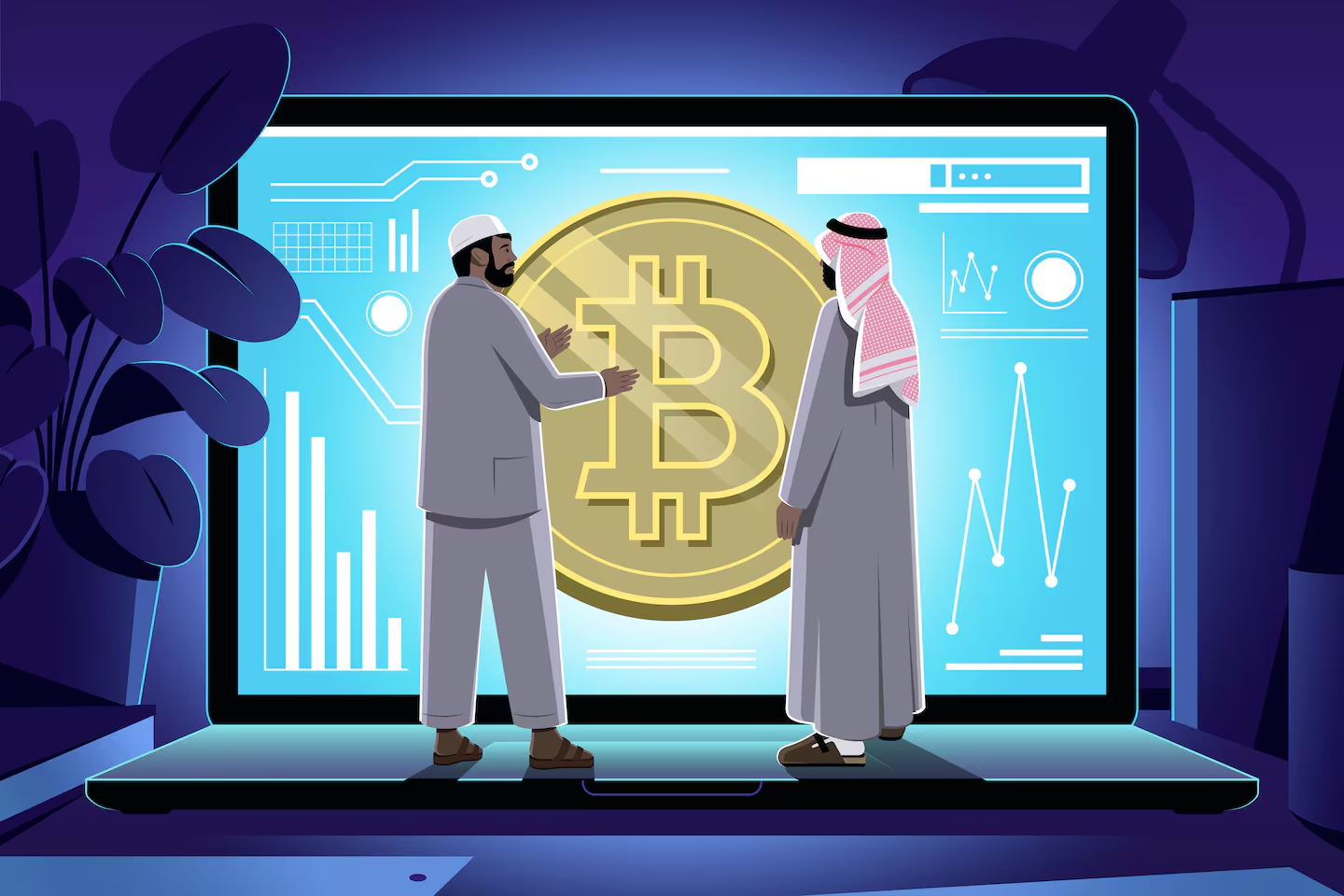
Cryptocurrency, as it is known today, started with Bitcoin as the first decentralised cryptocurrency in the modern world. The first Bitcoin transaction took place as far back as 2009 and ever since Bitcoin has grown into a global phenomenon bypassing traditional finance systems and banks. Islamic cryptocurrency, also known widely as Islamic coin, began to emerge in the late 2010s as the demand for Sharia-compliant digital assets grew.
Islamic coin is Sharia-compliant cryptocurrency that adheres to Islamic finance rules relating to financial transactions and exchange. This article will examine the benefits of Islamic coins and their relevance in the modern world of finance.
Cryptocurrency And Islamic Finance
Over the years Islamic finance and the world of cryptocurrency exchange and platforms have become increasingly interconnected. Islamic coin merges the traditional with the modern, uniting decentralised currencies with Sharia principles.
Not only does the Islamic coin stand as a testament to the thriving impact of Islamic finance on the modern world, but it also offers Muslims an alternative and innovative way of managing their money.
Two notable initiatives relating to Islamic coin are the First Islamic Crypto Exchange (FICE) and project Onegram. Project Onegram is a project that aims to create an Islamic cryptocurrency coin that is backed by gold reserves. Users of the coin are able to store their coins in a digital wallet and transact securely.
FICE is an Islamic initiative aiming to provide an Islamic digital platform for cryptocurrency transactions that are fully compliant with Islamic finance rules.
The main features of FICE are:
- it employs ethical screening
- it incorporates community governance within its structure and operations
- it offers Sharia-compliant trading
FICE and Onegram are both efforts to bridge the gap between Islamic finance and blockchain technology. The aim is to offer Sharia compliant solutions to Muslim investors in the realm of digital and decentralised finance.
Main Features Of Islamic Cryptocurrency
There are some key features that differentiate Islamic coin from other cryptocurrencies:
- Asset backing - Islamic coin is based on a system of asset backing. This not only provides intrinsic value but also stability in line with Sharia rules. Often the digital coin is pegged to assets that are tangible such as gold, real estate, silver, and commodities.
- Transparency: Islamic coin transactions must be transparent if they are to comply with Islamic finance rules. This means any trade, investment, platform being used, sales, prices, return, market, service, and exchange involved must be halal and transparent.
- Sharia law: Islamic coin must be Sharia compliant. This means the coin itself cannot be involved in any form of interest, uncertainty, or speculation.
- Governance: the governance relating to Islamic coins is usually decentralised. This is looked upon favourably by Islamic finance as it means there is more scope for the community to be actively engaged in the governance structures and processes.
- Regulation: Islamic coins, whether in the UK or abroad, must comply with regulatory frameworks that govern digital assets and finance. Digital assets are seen as a valuable commodity and many countries already have robust regulatory frameworks in place.
WHAT IS AN ISLAMIC COIN?
Islamic coins are essentially a form of cryptocurrency that is Sharia compliant. Muslims have an incentive to partake in Islamic coin trades and investment as they can be reassured that the coin is fully halal.
Of course, this means the coin must be certified as Sharia-compliant by experts with knowledge of Sharia law and rules.
For example, Islamic coin cannot be aligned or involved with any industry or market that is prohibited in Islam such as the gambling or alcohol industry. There is also a requirement that Islamic coin investment considers social benefit and social purpose as per Islamic finance rules. The ethics of the management and investment of Islamic coin are also important for adherence with Islamic finance.
WHAT ARE THE BENEFITS OF ISLAMIC COIN?
Islamic coin offers many benefits to its users:
- It is Sharia-compliant and aligns with Islamic principles
- It is transparent
- It is stable
- It facilitates the creation of strategic partnerships and ethical investment
- It provides innovative financial solutions
- It supports marginalised communities
- It uses ethical investment criteria
- It facilitates and enables financial inclusion
- It enables cross-border transactions
- It operates on a profit and loss sharing arrangement
- The HAQQ platform screens for Sharia compliancy
Islamic coins offer many benefits to Muslim participants and investors looking for halal ways to invest and trade. As the cryptocurrency financial ecosystem continues to evolve, Islamic coin will play a key role in shaping the future of Islamic cryptocurrency and digital assets.
WHAT IS THE DIFFERENCE BETWEEN ISLAMIC COIN AND BITCOIN?
When considering cryptocurrency, the question always arises about the difference between Bitcoin and Islamic coin. The main difference is that Islamic coin adheres to Islamic finance principles. The very existence of Islamic coin is to ensure that Sharia rules are complied with and there is no such obligation on Bitcoin.
Whilst both coins operate on decentralised platforms, Islamic coin should incorporate more transparent structures of governance leading to greater accountability and proof of adherence.
In addition, another key difference is that Islamic coin needs to follow ethical investment screening and criteria in order to the compliant with Islamic finance. Islamic coins operate on the HAQQ blockchain.
Whilst there are similarities in the nature of both Bitcoin and Islamic coin, the main difference is that Islamic coin adheres to a different set of values and principles. Users of Islamic coin will therefore seek assurance of compliance with Islamic rules relating to finances.
WHAT IS THE FUTURE OF ISLAMIC COIN?
More and more Muslims are looking to invest in and trade in Islamic coin. The Sharia Authority which was formed for the purpose of making decisions on the validity of cryptocurrency has stated that Islamic coin is a financial asset that can be traded whether that is by sale and purchase, or traded for goods and services.
Islamic coin holds great potential in the crypto world. As the crypto ecosystem and infrastructure continue to evolve there are some trends that suggest Islamic coin will see great growth in the coming years:
- Global financial inclusion: Islamic coin is playing a central role in making sure underserved Muslim-majority regions are able to partake in digital currencies. The demand is already there and is growing.
- Islamic finance growth: as the Sharia compliant finance industry grows so too does the demand for the accompanying digital ecosystem.
- Evolving markets: as the dynamics of markets in the world continue to grow and develop, Islamic coin is predicted to grow alongside them. Collaboration and innovations are already being seen across many different regions.
- Adoption: increased adoption of Islamic coins will lead to greater liquidity, market development, and acceptance.
WHAT ARE OTHER HALAL COINS TO INVEST IN?
Whilst the list of halal cryptocurrencies is growing, it is important to note that cryptocurrencies as digital assets are not deemed to be automatically compliant. They need to be screened by experts against Sharia principles. Some coins that have been deemed to be halal include:
- ZRX
- ELF
- Aion
- Alchemy Pay
- ASTA
- BEAM
- Cardano ADA
- Chainlink
There are many other coins that are deemed to be Sharia-compliant, but in each case you must do your own research and satisfy yourself.

The current cost of living crisis in the United Kingdom is affecting everyone. For many households, this is the highest squeeze on their finances that they have experienced. Many people are being forced to take measures in order to stay afloat. The cost of food, goods, and utilities are continuing to rise at an alarming rate, and people are having to make smart financial decisions.
According to recent statistics, up to 18 million households could face fuel poverty by January 2023 due to the ongoing energy crisis. Many of these families will have to decide between heating and eating. Investment bank Citi estimates that the UK consumer price inflation could reach 18% by early 2023. This will not only affect the finances of couples, and families with children, but almost everyone in the country.
This is why it is vital that you make smart financial decisions that could help you ride out this current cost of living crisis.
Let's have a look at some of the ways in which you can make your money go further.
Plan And Budget
One of the best things you can do is prepare a spending and budgeting plan. This will help you identify if you are overspending and examine those areas where you can cut back and save costs.
For example, do you still need to have a full Sky TV package? Can you get a cheaper broadband deal? Do you have any subscriptions that you no longer need or use?
Go through each direct debit and see if you can reduce or remove it. Check what you are paying for your smartphone packages and see if these can be reduced in any way. Ring your providers and ask them if they have any better deals on offer that could lower your costs.
Track all of your expenses and payments. This is the only way that you can successfully budget. Information and knowledge are power so use them to your advantage. Create a spreadsheet or table that lists all your incomings and outgoings, and then have a close look at where your money is going.
Muslims will already be used to the concept of planning and budgeting as they have to reconcile their finances and accounts every year in order to calculate their zakat calculations.
However, it is a good idea to keep a more regular eye on your finances, and remember that any drop in your income and savings may also affect your zakat and sadaqa payments.
Live Within Your Means
This is really important. It sounds so simple, but many people in the UK live beyond their means and this means they will struggle during the recession.
Having debt is not so much of a problem when times are going well. However, if you fail to make your repayments things could go wrong very quickly.
There is a famous Arabic proverb that states 'cut your coat according to your cloth'. Essentially, this encourages us to live within our means and not overstretch ourselves financially.
Islam does not look favorably on those who spend excessively and keep increasing their debt. We should all be looking at how we make use of our resources and expressing empathy for those less fortunate. Managing our finances well is something everyone needs to do, and needs to learn to do better.
Pay Off Debts
It might sound obvious but it is vital that you pay off any debts that you are able to. There are many online debt advice helplines that offer you recommendations and a guideline to help you reduce your debts.
You should prioritize paying off any debt, especially if it is a debt that accrues interest. Interest is not only strictly prohibited in Islam, but is also detrimental on your finances as the interest rates are likely to continue to increase.
If you can, pay off your debts.
Do Not Accrue New Debt
If you are thinking of taking on a new loan or new debt then think twice. Especially if the debt will be accrued due to a purchase that you do not necessarily need.
The same applies to buying things using your credit card. Now is not the time to be accruing more debt that incurs interest.
Start Saving Now
If you can, start saving now. It is never too late to start saving. Good financial management not only means monitoring your spending habits, it also means looking at your savings strategies.
You may need to undertake an evaluation of all your incomings and outgoings to see if there is anything you have left to save. If you do, even if it is a small amount, it is never too late to start saving.
If you do not have an ISA now is a good time to find information about what savings products are out there. For Muslims, there are some halal savings accounts that do not pay interest.
These halal savings accounts offer the same banking services as conventional savings accounts without interest.
Set Savings Goals
Set savings goals for yourself. This could be as little as saving £10 a month, to saving much more.
If you are saving to buy your first home, then you will likely be impacted by the increase in interest rates.
Look for banks and lenders that offer halal mortgages based on Islamic finance principles. Halal mortgages tend not to be as dependent on standard interest rate fluctuations and offer more stable repayment options.
Invest
Many people are scared of investing during a recession or economic crisis, but there are some good investments out there that can generate revenue and income.
Do your research and have a look at what investment opportunities are out there for you.
Investing in the right funds, stocks and bonds can be inflation busting. If you do your research you could find investments that offer a good rate of return. For Muslim investors, there is a range of halal investment options on the market which tend to be more stable than the conventional stocks and shares.
If you want to minimise the risk when it comes to investing, then try not to be too exposed to a limited number of sectors or assets. Diversifying your portfolio via investment is a good way to spread your money with less risk.
Think About Side Hustles
Side hustles have become popular in recent years when it comes to generating additional monthly income. Some low cost side hustles that have been successful in recent years include the following:
- Amazon selling
- Etsy selling
- Selling digital art and services
- Creating a website
- Freelance graphic designing
- Freelance writing
- Blogging and vlogging
- Social media influencing
- Shopify
- Dropshipping
- Creating online courses and offering advice
- Affiliate marketing and advertising services
- Starting a podcast
- Using comparison and cash back websites
These are just some side hustles that require very little financial outlay at the start.
Undertake Due Diligence Before Making Big Financial Purchases And Decisions
If you are thinking of making a big purchase such as a home or a car then make sure you do all the necessary research. Use comparison websites to find the best prices for things like electrical goods and holidays.
When it comes to home purchases, remember the housing market is likely to undergo some change in the coming months.
It might be better to sit tight to see if there is a fall in house prices. You should also look at different funding options such as halal mortgages. These types of mortgages tend not to have fluctuating rates as they are not interest based loans.
Take Your Time - Don'T Be Hasty
This is important. Now is not the time to make rash decisions or rush into big purchases or commit to long-standing and expensive monthly subscriptions.
Whether it is a smartphone or a new streaming service, take your time in deciding whether you definitely want to commit some of your monthly income to it.
WHAT IF YOU ARE SELF-EMPLOYED?
For the self-employed there are some additional concerns during a recession. For a start, whilst you may already be accustomed to fluctuating monthly income, you may see a drop in overall income as your customers feel the pinch and cut back on their spending.
Rising inflation is likely to affect all businesses, irrespective of size and industry.
Now is a good time to look at your personal finances, and check to see that you can:
- meet your mortgage repayments or rental payments
- meet all your essential direct debit payments for things like utilities
- have enough money to cover food and groceries for at least 3 months
- have some savings to fall back on in case your monthly income drops
- cut back on any non-essential items of expenditure
Some Ways You Can Protect Your Money
The Bank of England recently raised the interest rates. When this happens, it is usually an indication that the Bank of England wants people to start saving more and spending less.
Some ways to future-proof your money and savings include the following:
- Pay off as much of your existing debt as you can
- Make changes to your living standards that would bring your costs down
- Check to see if you can consolidate any of your debts
- If you have investments, check up on them and see how they are performing
- Save for a rainy day - even a few pounds a month will soon add up
- Track your spending by separating your wants from your needs
- Limit spending on gifts
- See if you can fix your mortgage if you are currently on a variable rate, there are some deals to be had out there
Introduction
Cryptocurrency is essentially a digital currency exchange and digital payments platform that uses blockchain technology. The technological and digital revolution over the last few decades has meant that innovative payment systems have been created and utilised, and cryptocurrency is one of the major breakthrough payment systems for business and personal finance use. Whether or not cryptocurrency is halal or haram is a debate that is ongoing between Islamic scholars.
This article will examine cryptocurrency, Islamic interpretations, and the types of cryptocurrencies available.
Cryptocurrency
Although there are over 2,000 cryptocurrencies on the market now, Bitcoin is probably still the most known form of cryptocurrency in the blockchain market, and was the first cryptocurrency coin to go mainstream but there are other cryptocurrencies entering the market.
For Muslims across the Islamic world, the question arises as to whether crypto payment platforms are deemed to be halal or haram in the eyes of Allah and in accordance with Shariah principles, and whether as a currency it prevents money laundering. Whether or not cryptocurrency is halal or haram depends on the how a specific cryptocurrency aligns with the principles of Islam.
Cryptocurrency - Characteristics
One of the defining aspects of cryptocurrency is that there is no central authority such as a Government that authorises it or records it. Cryptocurrencies operate on decentralised networks using blockchain technology.
Most cryptocurrencies have a limited supply, or at least a capped supply. Transactions are transparent and traceable, but there is also a degree of anonymity of parties. One the main advantages of cryptocurrency is that it offers global accessibility. It can be received anywhere in the world - all you need is an internet connection.
For Muslims, cryptocurrency does tick a lot of the Islamic finances boxes when it comes to transparency and traceability. However, ultimately it is the duty of every Muslim to be seeking knowledge, and this guide will address the use of the cryptocurrency market and its intrinsic value.
This article will consider whether crypto currency is permissible as a form of actual money under Islamic laws and in the Islamic world. We will consider the views of Islamic jurists and scholars on this emergence of what is considered to be new money addressing the question of is cryptocurrency halal.ISLAMIC SCHOLARS INTERPRETATION - IS CRYPTOCURRENCY HALAL?
A comprehensive Islamic law interpretation, one that sparked a massive rise in Muslim investment in Bitcoin and Ethereum in 2018, was provided by Sharia advisor Mufti Muhammad Abu-Bakar (former advisor to Blossom Finance) who looked at the question of is cryptocurrency halal as a money supply. He argued that Bitcoin is permissible under Islamic principles.
Mufti Abu-Bakar considered arguments that crypto itself was speculative when it comes to personal finance, but his view was that all currencies have a speculative element and this did not automatically deem cryptocurrency as haram.
Crypto Currencies
Islamically, if a business does not have an element of appropriate loss probability within its assets is not strictly trading in a Sharia compliant manner. The Grand Mufti of Egypt, Shaykh Shawki Allam believes that cryptocurrency is haram and he is joined by other Shariah scholars from the Middle East and beyond including Shaykh Haitham Al Haddad who see crypto as high risk. Their argument is based on the notion that crypto itself does not hold enough credibility as a currency to be deemed to be halal.
However, many other Sharia scholars believe that crypto itself does confirm to Sharia money rules and Muslims are permitted to invest in crypto.
Islamic scholars who believe that cryptocurrency money and digital assets are halal include Ziyaad Mahomed, Shariah Committee Chairman of HSBC Amanah Malaysia Bhd, and Mufti Faraz Adam. These views lend credence to the notion that Muslims can invest in crypto.
Arguments in favour of crypto being deemed halal include:
- There is often a lack of riba (interest). Crypto operates on decentralised platforms without any central authority. This usually means there is no interest charged or payable.
- Crypto is used as a medium of exchange with a legitimate purpose in financial and economic transactions.
- Technologically, crypto is neutral. Scholars argue that it is the use of the crypto that determines if it is Sharia compliant or not.
- The fact that crypto is generally thought to be scarce means that it is easier to avoid speculation and uncertainty and this aligns with Islamic finance rules.
Islamic Scholars
As mentioned above, one of the main reasons Islamic jurists and scholars from Muslim countries argue that cryptocurrency is halal, is that the concept of the blockchain and other cryptocurrencies are inherently anti-interest when looked at from a money generation source or perspective. Crypto operates outside of conventional banking systems and interest-based transactions.
Islamic banking laws are also anti-interest so the technology, pricing, and buying and selling of cryptocurrency money is deemed halal by many Islamic scholars who rely on the teachings of Prophet Muhammad PBUH when seeking guidance about permissibility (ultimately, only Allah knows best).
Given that crypto has a finite supply, it is less likely to be subject to inflation. This means it can maintain a fairly stable value - again an important element of Islamic finance.
Crypto Blockchains And Islamic Finance Principles
Blockchains refer to the blocks of technology used to record digital cryptocurrency transactions. Blockchains act as a system of record and the reason this form of technology is so important is that it is virtually impossible to hack, change or cheat the blockchain platform or marketplace.
With the use of blockchain, centralized financial institutions and establishments are not needed as no central control is required. This also means that crypto trading (and the stock market) is more transparent.
According to many Islamic scholars and religious leaders, this addresses the question of is crypto halal within Islamic Finance rules and Islamic law more generally.
As cryptocurrency money is deemed permissible and halal under Islamic Sharia rules this has unlocked the crypto investment market to a global Muslim community with increasing numbers of Muslims with an interest in buying crypto and use it as a form of currency.
In terms of business practices, there are some basic principles (discussed in this article) relating to crypto and cryptocurrency trading that help many Muslims to decide if their entrepreneurial journeys and endeavours are permissible or strictly prohibited.
Consideration And Commercial Value - Is Crypto Halal Or Haram
From the perspective of Islamic contract rules, there must be an element of consideration when answering the question is crypto halal - there must be Mal. Mal refers to possession and effective storage, and cryptocurrencies meet the criteria required as they can be possessed and stored and have commercial value (Mutaqawwam).
Crypto is a real and viable digital asset, its worth and value lies in what is paid for it, and it is capable of being owned and traded commercially so the Shariah requirements are satisfied and the the question of is crypto halal can be answered.
Shacklewell Lane Mosque
The Shacklewell Lane Mosque in East London became one of the first mosques in the UK to accept cryptocurrency donations and Zakat contributions in 2018 during Ramadan. This mosque deemed cryptocurrency halal and permissible and generated a lot of interest on the topic of the permissibility of crypto more generally under Islamic law.
Digital Currencies, Money Laundering And Shariah Law
Islamic finance principles dictates that in order for income, or investing in any product or asset, to be deemed halal it has to meet certain criteria. The principles of Shariah law should be applied to the financial systems we operate in and there has been some discussion amongst Muslim scholars about whether rules devised centuries ago can still be applied to a technologically modern digital financial marketplace.
Whether cryptocurrency is halal or haram centres on the rules of Sharia law.
Is cryptocurrency halal? For many Islamic scholars, the answer quite simply is yes. Shariah principles can be applied to modern crypto analysis and digital currencies as they are based on social justice, accountability and ethics which transcend all forms of financial transactions. As long as there is no illegal activity, then trading or investing in crypto should not be deemed to be contrary to Shariah principles.
Investments, Islamic Banking Law And Illegal Activities
There has been some discussion amongst Muslim scholars around the use of cryptocurrencies for illegal activities such as gambling, drugs, and money laundering. Critics of Bitcoin also argue that it is not legal tender as it is not backed by any central government that assigns its value and maintains regulatory standards, and it is therefore deemed to be speculated trading.
However, Islamically the use of an item that is deemed halal for an unlawful purpose does not make the original item halal. Whether it is halal or haram depends on the multiple factors.
Currency Ownership
Ownership of the currency remains with the owner according to Muslim scholars, and the coins/tokens are kept in an e-wallet. This means that investors can take part in trading as and when they want, retaining control of their assets.
As mentioned above, the publication of the working paper conducted by Mufti Muhammad Abu Bakr clearly identified that cryptocurrency is permissible under Shariah rules.
For Muslims worldwide this could have huge implications for the payment of Zakat monies that are made to the poor and to charities globally. If Muslims make up 25% of the world's population and hold approximately £1.04 billion in bitcoins, this means that £26 million is due in Zakat contributions. [1]
Medium Of Exchange
Cryptocurrency operates as a medium of exchange across the globe. This means that it can operate in legally diverse and unpredictable environments, often making it more accessible than mainstream finance options. It is a valid form of currency that holds purchasing power.
Although vulnerable to market changes, crypto coins such as Bitcoin and Ethereum are deemed to be a legitimate medium of exchange, available for use in transactions and trading. Although crypto has not yet reached the status of being a globally accepted medium of exchange, it is fair to say that it is on the way to becoming so. Commentators expect crypto to appreciate over the course of time and to store value.
Cryptocurrency Guidelines
The development of Shariah compliant cryptocurrency guidelines provides Muslims with the opportunity for ethical investments. From a financial perspective, Islamic charities could benefit hugely from Zakat and other donations as a result of crypto investment.
Many banks and financial establishments globally are recognising crypto as a financially viable medium of exchange, and this makes it easier for investors to continue to trade, buy and sell cryptocurrency.
With billions of Muslims worldwide, and the growth of crypto, it seems clear that what is perhaps needed is some form of shariah compliant cryptocurrency guidelines for Muslims to follow. This would enable Muslims to assess themselves the validity of cryptocurrency when assessed against Islamic finance rules.
Contracts
In terms of whether contracts relating to crypto are Shariah compliant, given that the contractual relationships in crypto are based on smart contracts using blockchain technology, this means that the process can be made increasingly secure and automated.
This not only reduces administrative complexities, confusion and errors, but also ensures that banks are more likely to accept the contractual relationships created.
In demonstrating Shariah compliance, cryptocurrency is earning legitimacy across the Islamic finance world. Cryptocurrency agencies are springing up across the Muslim world such as One Gram in Dubai, and Hello Gold in Malaysia.
This adds further legitimacy to the rulings that cryptocurrency is halal and can be utilised by Muslims and Islamic financial institutions. Of course, there needs to be ongoing discussion to consider is crypto halal as it operated within a dynamic and changing industry.
As the crypto market continues to evolve more questions will need to be asked, and each crypto coin should be analysed against Islamic finance principles to check for permissibility. However, as things stand right now, crypto is recognised as an asset under Sharia law and this lends it legitimacy. The things to be careful of are making sure that any cryptocurrency you are involved in does not link to any haram things and industries or activities or any form of money laundering.
Whilst there is no central body who can make a final ruling on whether crypto is halal or haram, but as there is no element of interest (riba) and no exorbitant fees relating to crypto the interest from Muslims is growing. Crypto can be used within Islamic finance principles to make ethical investments and wealth management in a Shariah compliant way. This could unlock the cryptocurrency investment market to billions of Muslims worldwide who are looking to enter the crypto market as investors.
As the currency is still in its infancy it is important to keep an eye on all new developments and to assess and analyse changes in the marketSource:
[1] https://www.independent.co.uk/life-style/gadgets-and-tech/news/bitcoin-halal-london-mosque-donations...
Stay informed on finance